
About us
Police and Crime Panel
The Police and Crime Commissioner is required to attend the quarterly Police and Crime Panel meetings, which are open to the public and press to observe.
Police and Crime Panel
The Police and Crime Panel supports and challenges the Commissioner in carrying out their functions. The panel has the power to request reports and call the Commissioner to attend its meetings.
The Police and Crime Commissioner issues progress reports on delivering towards the objectives within the Police and Crime Plan and of the performance of their office.
The Commissioner reports to the Police and Crime Panel regularly. This information is available from the Panel’s website here.
Police and Crime Panel meetings are broadcast live on the Plymouth City Council YouTube channel where you can also watch past meetings.
To view the Police and Crime Panel meeting agendas, reports and minutes, please click on the relevant tiles below. Scroll down to view documents relating to the council tax precept and the Devon & Cornwall Policing budget.


Equality and diversity
Browse our documents
You can search and view our documents below.
Tip: Use the breadcrumb trail above the search bar to return to previous folders and navigate the document library.
Where no documents are displayed when using the search function or clicking on a folder, no document is available.
-
Equality impact assessments
Equality impact assessments
Publishing Equality Impact Assessments (EIAs) is a key way the Office of the Police and Crime Commissioner demonstrates its commitment to fairness, transparency and accountability. As a public authority, the office must show how its decisions, policies and commissioning activity affect different people and communities, particularly those with protected characteristics. EIAs provide a structured way to consider these impacts at an early stage, helping to identify and address any potential disproportionate or unintended effects.
By making Equality Impact Assessments publicly available, the office shows how it meets its legal duties under equality legislation and how equality considerations are embedded in decision-making. This openness helps build public trust, reassures communities that their needs are being taken seriously, and supports better, more inclusive outcomes in policing and crime services.
Social media house rules
The communications and customer contact team are responsible for the Commissioner’s social media presence. Our accounts aim to explain services, initiatives and decisions taken and to answer questions you may have on them.
We want you to join the conversation and to comment on what we and others are saying. While we read all comments and aim to be as responsive as possible, we cannot respond to every individual comment. We will however ensure that any common themes or helpful suggestions are passed to the relevant council team.
We have a short set of house rules to help everyone to understand what we consider to be acceptable and unacceptable.
We support and encourage free speech and don’t want to have to remove any content, so please try and keep your contributions within these house rules. If these rules are broken, we may issue you with a warning about your future contact.
For serious or persistent breaches of these rules, we reserve the right to prevent users from accessing our pages and/or report them to the platform and/or the relevant authority.
Political comments during the pre-election period of heightened sensitivity
During the pre-election period, Commissioners must be particularly vigilant in monitoring what is posted on their accounts. Comments or posts that could be seen as relating to any political party or candidate will be deleted.
Do not use our social media platforms to bully or harass others
We will not tolerate any form of direct or indirect bullying, harassment or victimisation of other users or of our staff or the elected officials we serve and we take this behaviour extremely seriously. Please let us know if you feel people are using our page to bully or intimidate you and we will remove the offending comments and consider removing that person from our site. We won’t reply to abusive messages and may take sanctions against anyone posting messages of this nature.
Don’t spam or troll us
Spam is the term that describes any kind of unwanted online communication. If you spam our page, we reserve the right to delete it and may ban persistent spammers.
We will not respond to people who post hostile, abusive, condescending, sarcastic or offensive language that is intended to belittle or intimidate and will take action, which could include banning them.
This is because these types of posts can spoil other people’s experiences of using our page.
We will also remove any posts that advertise private businesses or services.
What you say is public
You are wholly responsible for any content that you choose to post or share on our social media accounts. Any posts containing misleading or deceptive information may be removed. We will also remove posts that unnecessarily name OPCC officers or staff.
We reserve the right to restrict comments on our posts where appropriate.
Commenting on ‘live’ cases
If police have made arrests and a trial is possible, making a public comment relating to a case may be considered to be in contempt of court. This is a serious offence which may derail the criminal justice process. Comments deemed to be in contempt of court may be removed without notice.
Please be respectful
We will not accept swearing, abusive or offensive language and will remove any comments that contain them. This includes racist, sexist, sexually explicit, homophobic or otherwise offensive remarks.
In cases where comments incite hate based on race, religion, gender, nationality, sexuality or other personal/protected characteristics (as defined in the Equality Act 2010), and sexually explicit content, we will consider reporting the comment to the police.
We also reserve the right to hide or remove comments that are likely to disrupt, provoke, attack or offend others.
What to do if you don’t agree with others’ comments
People are encouraged to submit comments on our social media channels in the spirit of free and open dialogue and debate. If you disagree with a comment on our page, you are welcome to add a reply to express this, provided you stay within these house rules. However, if you do wish to formally complain about material posted, by another person, you can let us know by contacting us.
False identities
If it’s clear you aren’t who you say you are we will remove any content you’ve posted and may block you from our page.
Respect confidentiality
Please don’t post confidential or private information on our pages, as they are a public forum. This includes sharing your own phone number, email address or other contact details, or anyone else’s. If you need to share this kind of information with us, please contact us.
Reporting social media posts
If you are offended by another user’s post, please report it to the relevant platform. If you would like us to remove it, please contact us and we’ll investigate.
What we’ll do if you break the rules
If we see users on any of our social media channels breaking any of the rules, we may hide the comment/s or replies. This means although your comment/reply is still posted, it will not be easily visible to other people and depending on the channel this may only include you and your connections.
If you post personal information (your own or other people’s) we will hide the comment or reply and advise you to remove it. If you need to provide personal information please only use a private or direct message. Personal information may include your address, phone number, email address.
If a user is spamming us from what is clearly a fake profile, we will immediately report the post to the channel and block the user. A fake profile is unlikely to have a real name or may be purporting to be an official channel profile, will typically have no or few followers, a new or relatively new account and have no connection to the UK or Devon and Cornwall. Spam posts often tag multiple accounts and direct to links unrelated to the channel in an effort to phish log in details.
If you repeatedly break these rules from a genuine profile we will consider blocking you from the council profile/page on the channel/s you are posting on.
If appropriate, we will issue you with a warning on the channel/s you are posting on and then monitor your comments over a period to provide a record if you continue breaking the rules. This record will be presented to the Communications and Customer Engagement Manager to confirm if a block is warranted. If it is confirmed that a block is warranted, this will take place without any further warnings.
In some cases, behaviour may warrant an immediate block at the discretion of the Communications and Customer Engagement Manager without a warning. We may also report comments to the police, depending on their nature and content, and you may be considered a vexatious customer.
A block is not time limited. If your account is blocked and you wish to discuss this, please contact the Communications and Customer Engagement Manager by contacting our office. If you have been blocked and wish to raise a service enquiry, please use a reporting form or contact the council.
Data protection
UK General Data Protection Regulation (UK GDPR) and the UK Data Protection Act 2018
The UK GDPR is a legal framework that sets out guidelines for the collection, use and sharing of personal information of people within the UK. It originally came into effect as a piece of EU legislation (the ‘EU-GDPR’) on 25th May 2018. The GDPR was retained in domestic law as the UK GDPR after the UK left the European Union, but the UK has the independence to keep the framework under review.
The Data Protection Act 2018 received Royal Assent on 24 May 2018. This Act updates data protection laws in the UK, and sits alongside the UK General Data Protection Regulation (UK GDPR). The Act implements the EU Law Enforcement Directive, as well as extending domestic data protection laws to areas which are not covered by the UK GDPR.
Our commitment to Data Protection
Keeping your personal information safe and secure remains our top priority and we are working to update our policies and procedures to ensure that we comply with Data Protection legislation.
To promote transparency in the way we process personal data, we are developing privacy notices for each area of the Police and Crime Commissioner’s work to offer more detail on what personal data we collect, how we use it and your rights.
We are publishing our policies and procedures on this page as they become available.
Guide to exercising your rights under Data Protection (subject access rights)
Associated processes and service standards
Privacy notices:
- Community contact and correspondence
- Third party intelligence
- Victim Care network distribution list
- Neighbourhood Alert (community messaging)
- General
- Volunteer and independent roles (associated legitimate interest assessment)
- Human Resources, staff health, safety and wellbeing
- Work experience /work placements (assocated legitimate interest assessment)
- Website cookies
Appropriate policy document for the processing of special category and criminal offence data (not law enforcement)
Statement on consent (children)
Records and Information management policies (including Data Protection Policy)
Our policies
This page provides you with links to the policies that affect the operation of the Office of the Police and Crime Commissioner (OPCC).
Whistleblowing
Under the Employment Rights Act 1996, workers who suspect wrongdoing in the workplace and disclose their concerns (i.e. a “Whistle Blower”) are protected from dismissal and from being subjected to detrimental treatment or victimisation, provided certain criteria are met.
These provisions derive from the Public Interest Disclosure Act 1998, which introduced additional sections into the Employment Rights Act 1996. Below you will find our policy outlining how we will deal with our obligations on receipt of disclosure information.
Human resources
The OPCC has a number of policies which deal with employment issues and are a framework for dealing with a variety of issues.
Our policies are currently being reviewed. Please contact Caroline Coles at caroline.coles@dc-pcc.gov.uk to request the relevant policy.
You can view the OPCC staff code of conduct here.
Records and Information Management
The Police and Crime Commissioner is committed to the creation, retention and management of records and information which document the principle activities of the organisation.
All staff are under a statutory obligation to create accurate records of their activities and to manage and maintain such documentation. The organisation has a responsibility to comply with legal or statutory regulations and records and information must be managed to fulfil these responsibilities.
Browse our documents
You can search and view our documents below.
Tip: Use the breadcrumb trail above the search bar to return to previous folders and navigate the document library.
Where no documents are displayed when using the search function or clicking on a folder, no document is available.
Please note, we are in the process of updating our document library. If the document you are looking for is missing, please contact our office.
-
Records and Information Management
-
Whistleblowing
Police and Crime Plan
We all deserve police and criminal justice services you can trust and have confidence in.
The Chief Constable needs to deliver a service that is consistently assessed as good – by both national inspection standards and by the people we serve in Devon and Cornwall.
To address this the Chief Constable will need to deliver a consistently high standard of crime investigation which supports victims, and lead a police force which demonstrates the highest level of police conduct and professional standards in everything it does.
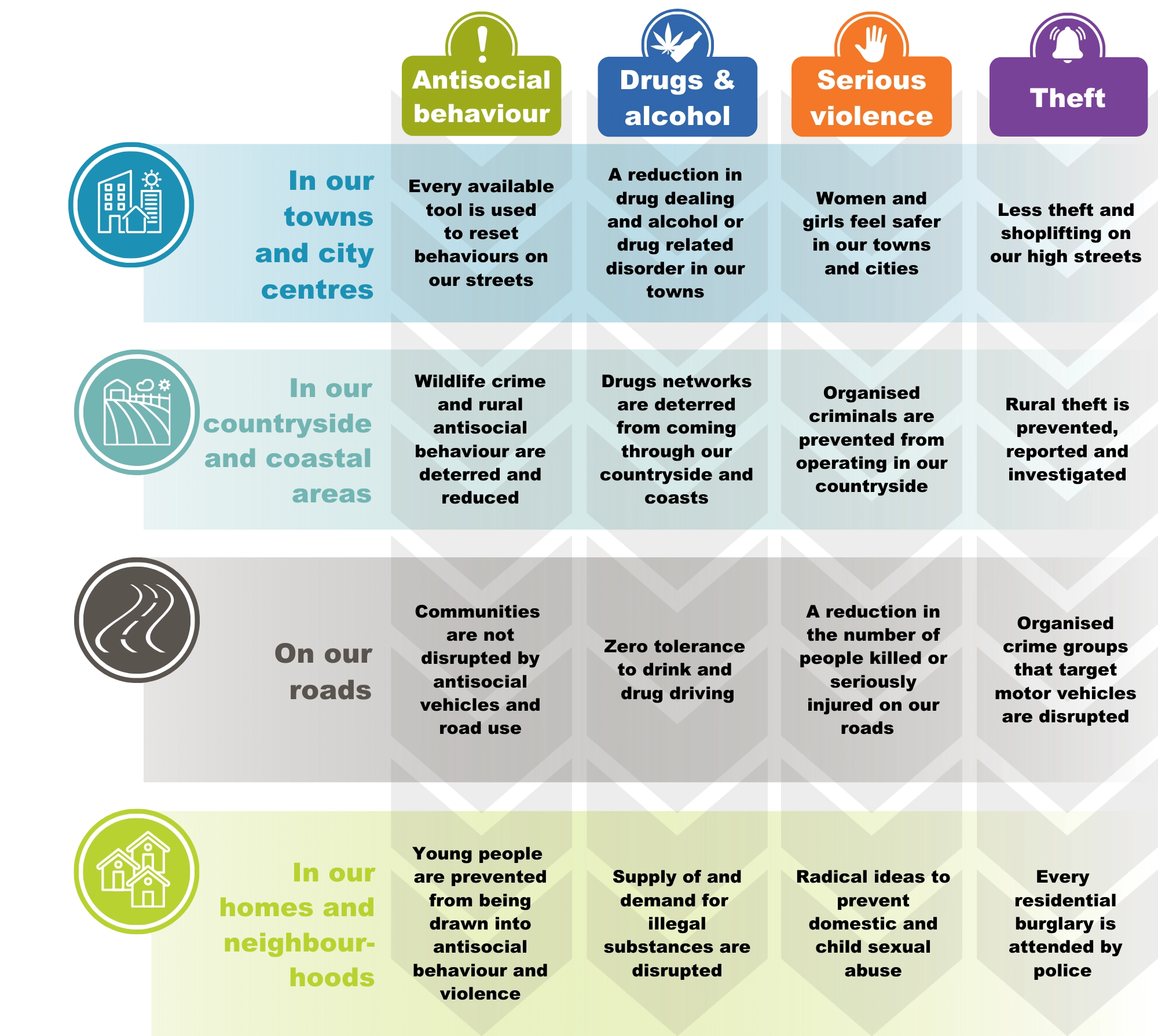
This plan sets out how the Commissioner intends to achieve this, and the priorities set for policing, based on data and public consultation.
Looking for a print-friendly version?
Scroll down to download the plan from our document library.
Devon & Cornwall policing priorities





Browse our documents
You can search and view our documents below.
Tip: Use the breadcrumb trail above the search bar to return to previous folders and navigate the document library.
Where no documents are displayed when using the search function or clicking on a folder, no document is available.
Please note, we are in the process of updating our document library. If the document you are looking for is missing, please contact our office.
Decisions and approvals
Decision making by the Police and Crime Commissioner is based on the principles of good governance – about people in public office doing the right thing, in the right way, for the right people in a timely, inclusive, open, honest and accountable manner.
Decisions made by the Police and Crime Commissioner are informed, open and transparent. The police and crime commissioner will seek, where possible, to give advance notice of when significant public interest decisions will be made.
Below you can find the ‘decision making records’ that support those decisions. These records contain the background information considered and the decision that was approved. Where a decision or approval was taken to the Policing and Crime Joint Executive (PCJE) or the OPCC Executive Leadership Board this is indicated. All downloads are in PDF format.
The decision-making process that the Commissioner and their office follows can be found here. If a decision or approval notice you would like to view is not listed here, or you would like to see supporting documents referenced in these notices, please contact our office.
The Office of the Police and Crime Commissioner also demonstrates its commitment to fairness, transparency and accountability by publishing Equality Impact Assessments (EIAs) to show how its decisions, policies and commissioning activity affect different people and communities, particularly those with protected characteristics.
You can find out more on the Equality Impact Assessments page.
Browse our documents
You can search and view our documents below.
Tip: Use the breadcrumb trail above the search bar to return to previous folders and navigate the document library.
Where no documents are displayed when using the search function or clicking on a folder, no document is available.
Please note, we are in the process of updating our document library. If the document you are looking for is missing, please contact our office.
-
2026
-
2025
-
2024
-
2023
-
2022
Cookie policy
What are cookies?
How do we use cookies?
Manage cookie preferences
You can change your cookie preferences any time by clicking the above button. This will let you revisit the cookie consent banner and change your preferences or withdraw your consent right away.
In addition to this, different browsers provide different methods to block and delete cookies used by websites. You can change the settings of your browser to block/delete the cookies. Listed below are the links to the support documents on how to manage and delete cookies from the major web browsers.
Chrome: https://support.google.com/accounts/answer/32050
Safari: https://support.apple.com/en-in/guide/safari/sfri11471/mac
Internet Explorer: https://support.microsoft.com/en-us/topic/how-to-delete-cookie-files-in-internet-explorer-bca9446f-d873-78de-77ba-d42645fa52fc
If you are using any other web browser, please visit your browser’s official support documents.