
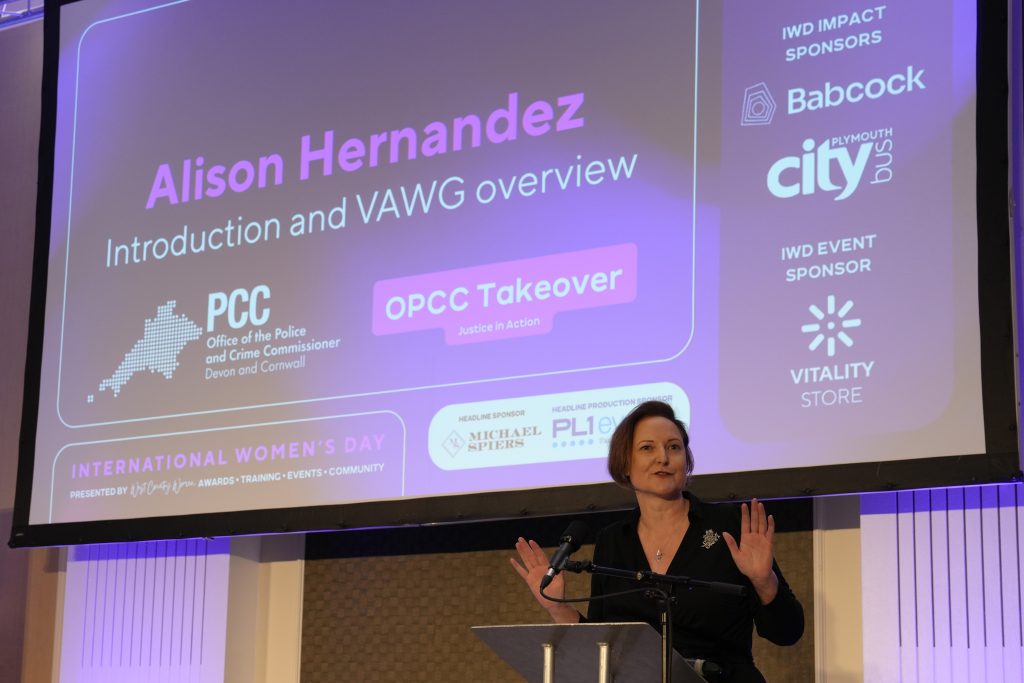
I was honoured to be among a roomful of more than 200 incredible women from across the region at an inspiring event last week in celebration of International Women’s Day and to explore how violence against women and girls (VAWG) can be tackled.
My office was proudly one of the sponsors of the West Country Women’s International Women’s Day Plymouth 2026: ‘Rights. Justice. Action’ which included hosting a one-hour takeover on the theme of justice.
Devon & Cornwall Police’s Assistant Chief Constable Nikki Leaper took time out of her busy schedule to share how she was cruelly subjected to misogyny at the beginning of this year after simply providing a message of reassurance on the force’s Facebook page about the disposal of an unexploded Second World War bomb in Exmouth.
Despite all the many great things she has achieved during almost 23 years’ service with the police, she instead received unacceptable and hurtful comments about her appearance and gender. ACC Leaper has more than proven herself to be a dedicated and well-respected officer, but on social media that was not how she was judged.
It is a sad reflection of how misogynistic and hateful comments have become a ‘normalised’ part of society, especially for females in leadership positions or those in the public spotlight. I too have been at the brunt of unkind and appalling personal comments which male Police and Crime Commissioner’s will have never experienced or ever will.
For far too long, females have endured living in a culture where it is accepted as being the “norm”. Misogyny has no place in society and neither does violence against women and girls (VAWG). That is why my office is extensively funding initiatives to combat it once and for all.
One of those, an impactful programme called Let’s Talk, was a key part of the OPPC’s justice hour. Rebecca Hewitt, who won last year’s OPCC Combating VAWG category at the West Country Women Awards, explained how £100,000 of OPCC funding will help empower parents and carers by raising awareness of the community safety risks and challenges faced by young people such as pornography, drugs and alcohol and relationships, while providing simple tips to support them.
The money will also help towards delivering important work including live online sessions to parents, carers and professionals, a Let’s Talk Dad’s Campaign and themed sessions such as misogyny.
Rebecca Hewitt, who is Teignbridge District Council’s strategy and policy manager and chair of South Devon and Dartmoor Community Safety Partnership, also explained how vital it is to have a ‘whole community approach’ to tackling VAWG.
This is also something I have strongly believed in for a long time which is why last summer I hosted a groundbreaking one-day disruptive workshop in Exeter, inviting around 100 frontline professionals to contribute radical ideas aimed at disrupting VAWG. The workshop engaged a broad coalition of stakeholders, including police officers, council representatives, charities, victim services and policy makers.
Since then, those ideas have continued to evolve and develop with more exciting news to come this year about some of those plans. But in the meantime, I am pleased that throughout March, my office is using grant funding from the Ministry of Justice to offer vital new training to help frontline professionals identify and respond to evidence of stalking.
The sessions are being delivered online the Hollie Gazzard Trust – an exceptional national charity set up by the family of Hollie who was subjected to coercive and controlling behaviour and was tragically murdered by her ex-partner.
Last week, I welcomed the sentencing of 19-year-old unremorseful Sonny Boyes who was jailed for 17 years after being found guilty of nine sexual offences, including two counts of rape, against two teenage girls in Exeter. One victim was raped after getting off a train at Digby & Sowton train station, and the second victim was sexually assaulted both on the platform and onboard the train.
Throughout the criminal justice process, he was said to have had demonstrated misogynistic views and even while in custody had continued to show derogatory behaviour towards females he had encountered.
Women and girls should not have to feel unsafe to travel on public transport or in any aspect of their everyday lives. That is why my office is exploring ways to make train travel safer in our region.
It is also why we are focusing funding on education and early prevention to eradicate misogyny because only then will we finally see change that is far too long overdue.