
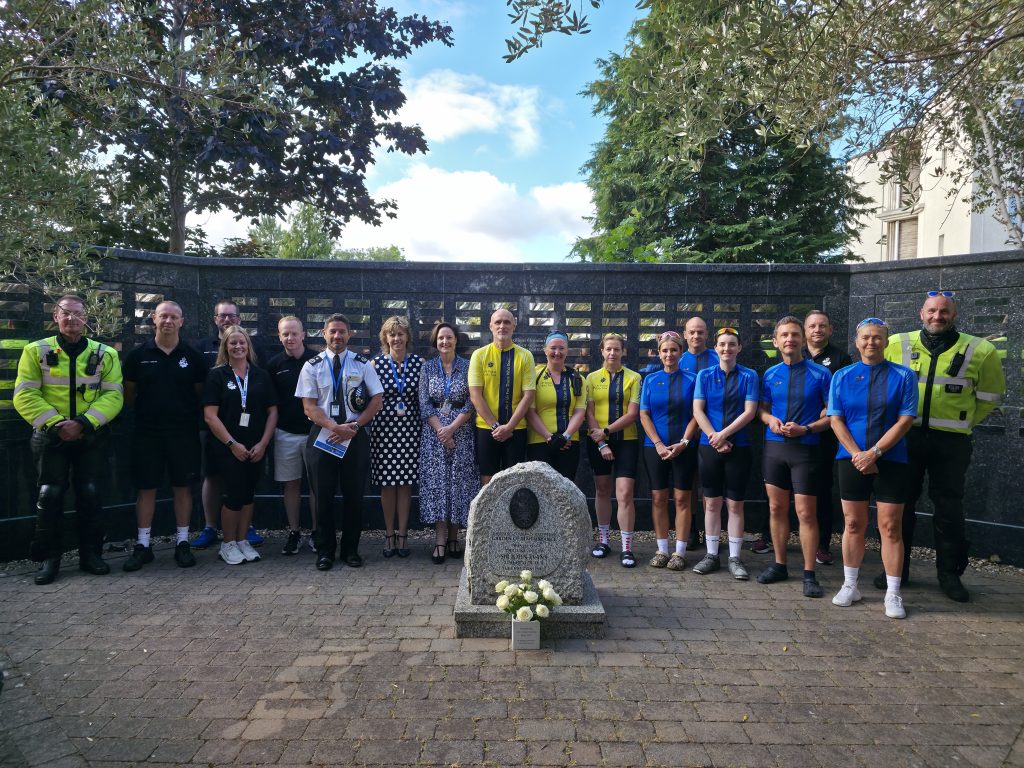
Last week, seven members of our policing family set off from Middlemoor Headquarters on a five-day, 350-mile cycle to the National Memorial Arboretum in Staffordshire as part of the Police Unity Tour.
The ride brings together officers and staff from police forces across the UK to remember colleagues who have died on duty and raise money for Care of Police Survivors (COPS), a charity that supports the families they leave behind.
I’ve often said that policing is about people. Behind every statistic, crime report or policing operation are individuals, families and communities. The Police Unity Tour reminds us of that perhaps more than any other event in the policing calendar.
Each rider wears a memorial wristband carrying the name of an officer or member of police staff who died while serving the public. At the end of the tour, those bands are presented to surviving family members during the COPS Service of Remembrance. It is a simple but deeply meaningful way of showing that their loved ones are not forgotten.
This year, the Devon and Cornwall team was riding in memory of Police Constable Richard Hulse, Police Constable Michael Hunns, Sergeant Paul Hutchinson, Police Constable Duncan McIntyre, Police Constable Ian Parsons, Police Constable Martin Reid and Police Constable Kevin Sparks.
Among the riders was our Head of Communications and Public Affairs Ben Woolvin, who was riding in memory of PC Hulse, who collapsed while on duty at Ashburton Police Station in 2005. Ben told me he signed up to support families affected by line-of-duty deaths and to thank officers and staff who put themselves at risk to protect others every day. He also admitted he felt a few nerves when he realised the challenge ahead was definitely happening and I suspect he wasn’t alone in that.
I watched the riders setting off and took part in a memorial service led by Deputy Chief Constable Jim Colwell. What struck me most was Mr Colwell’s reflection that the spirit of teamwork, collaboration and resilience required for this challenge is also firmly at the core of policing in Devon and Cornwall.
It is also a reminder that the tour is not really about the miles covered or the physical challenge. It is about the person whose name is on that wristband and the family who continue to live with that loss.
In Devon and Cornwall, since the Second World War, 15 officers have lost their lives while on duty, and many more have been at risk of losing their lives – some in deliberately targeted attacks. In recent years we have seen officers set on fire, thrown over a balcony, and seriously injured in collisions during pursuit of a suspect.
When a police officer or member of staff dies on duty, the impact extends far beyond the workplace. Families lose a loved one, children lose a parent and communities lose someone who dedicated their life to helping others.
This is in the forefront of many people’s minds as the tragic death of PC Andrew Harpers, who was fatally injured in 2019 after responding to the theft of a quad bike in Berkshire, is in the national headlines once again as two of his killers become eligible for early release next year after serving half of their 13-year sentence.
The work of Care of Police Survivors is so important. The charity provides practical and emotional support, peer networks and counselling to help families rebuild their lives after unimaginable loss. As one survivor explained: “Your loss is a part of who you are, but COPS helps you realise that it doesn’t define you. We are all one big family.”
The Police Unity Tour reflects many of the values that sit at the heart of policing in Devon and Cornwall. It is about community, resilience and people supporting one another through difficult times. It is about recognising service and ensuring that those who have sacrificed so much are remembered.
So, I want to thank the Devon and Cornwall team for taking on this huge challenge. Thank you for supporting such an important cause. And thank you for helping to ensure that those who died serving the public are never forgotten.