
Funding for vital spiking prevention training and drink-protectors is being provided by Devon, Cornwall and Isles of Scilly Police and Crime Commissioner Alison Hernandez to help combat what has now been recognised as a specific criminal offence in the recent Crime and Policing Act 2026.
Spiking prevention, early identification and effective response training will be given to security guards, bar staff and student union representatives at the University of Exeter and Falmouth University.
In Newquay, people working within the nighttime economy, including its busy pubs and clubs, can also benefit from the training.
It will be delivered by Exeter-based Stamp Out Spiking, the UK’s national charity tackling spiking. Its founder, Dawn Dines, has relentlessly campaigned for more than 20 years for clearer and stricter laws to be implemented around spiking.
Stamp out Spiking has received community safety funding from the Office of the Police and Crime Commissioner (OPCC) to help it achieve those aims. Additional funding of £10,000 will be used to help Stamp Out Spiking expand its prevention and response work across the South West. It will also include distributing anti-drink spiking protective covers which forms part of the Commissioner’s programme to explore ways to disrupt, reduce and combat violence against women and girls.
Stamp Out Spiking has long called for reforms that improve public understanding, increase reporting, and strengthen the criminal justice response to spiking which remains widely underreported and too often goes unprosecuted.
A new criminal offence of administering a harmful substance without consent, including spiking, has been introduced under the Crime and Policing Act 2026 which received Royal Assent – the final step that turns a bill into law – on April 29.
Dawn has described it as a major milestone because it replaces an “outdated” previous law under the Offences Against the Person Act 1861 that covered spiking.
Dawn, who was winner of the OPCC’s Combating Violence Against Women and Girls Award at the West Country Women Awards in 2024, said: “Some campaigns take years. This one has taken decades. This change matters because it makes the law clearer and more visible.
“That clarity is important for victims, for police, and for every venue and organisation that wants to do the right thing. But the law is only one part of the solution. Prevention and proper response on the ground still matter, every single day.”

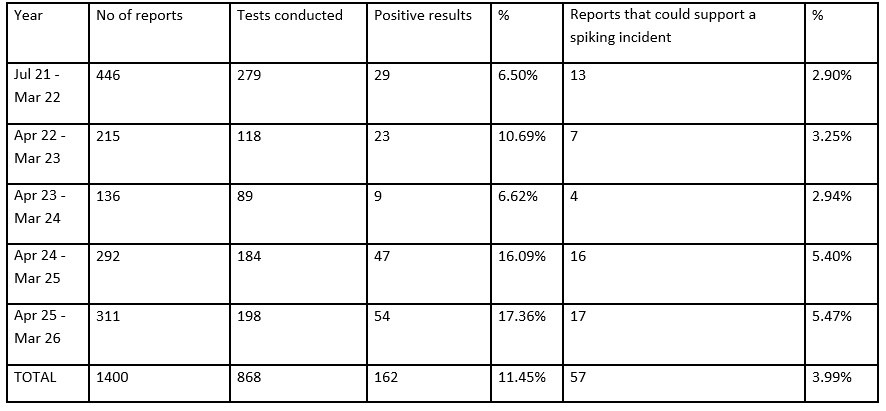
According to latest statistics from Devon and Cornwall Police, the number of reported spiking incidents between April 1, 2025, and March 31, 2026, was 311 – a slight increase from the previous year when there were 292 recorded.
Of those incidents reported from 2025-26, 198 tests were conducted. Of those, 17 – 5.4 per cent – confirmed a spiking incident, compared with a national average of six per cent.
However, Stamp out Spiking believes that all those figures are much higher because many people don’t report incidents to the police. But things are improving. The charity’s annual survey suggests there has been a 20 per cent rise in reporting.
Commissioner Hernandez said: “I urge anyone who believes they have been spiked to immediately seek help and report it to the police because it is only then that we can make nights our safer for everyone and ensure perpetrators are held to account for their inexcusable actions.
“Dawn has been a true inspiration in showing how the formidable determination of one passionate woman can result in such impactful change. She has lived and breathed her campaign to protect people from the dangers of spiking which quite rightly deserves to be treated as a serious crime.”
Dave Flynn, alcohol licensing sergeant for Devon & Cornwall Police, said: “We welcome this support from the OPCC and the work of Stamp out Spiking to build on the ongoing inputs the Alcohol Licensing Team give to licensed premises throughout the force along with our partners and stakeholders in support of encouraging awareness in venues and amongst staff to support victims and encourage early reporting to police.”
Police have reassured that although spiking incidents do take place across Devon & Cornwall, they are rare and urge anyone who suspects they have been spiked to report it.
Martin Tregaskes, Drug & Alcohol Harm Lead Inspector for Devon & Cornwall Police said: “All forms of spiking such as through drink, needle, food or vape have previously been prosecuted under a range of criminal offences depending on the circumstances. The new administering a harmful substance offence – which pulls these all together – is very welcome.
“Any form of spiking is harmful and the consequences for anyone found to have spiked another person in any way can be severe, including long custodial sentences.
“People should be reassured that incidences of spiking remain rare in Devon and Cornwall. However, it remains vital that people report any incident of spiking or suspicious behaviour to the police as soon as possible so that victims can be safeguarded and evidence gathered.”
He added: “Feedback received from the public by our Alcohol Licensing Team, who conduct year round awareness raising and staff training in licensed premises, reveals that the public are most concerned about people who put extra alcohol into other people’s drinks without them knowing. Be in no doubt that this is illegal, has always been illegal, and should never be done out of a misguided belief that it is just for fun.”
To report an incident of spiking, please call Devon & Cornwall Police on 101 or visit www.dc.police.uk/spiking You can also report on behalf of someone else. If the suspect is still at the scene or if anyone is in immediate danger or needs medical help call 999.
For more information about Stamp Out Spiking, please visit https://stampoutspiking.org
Spiking stats for Devon and Cornwall since 2021