
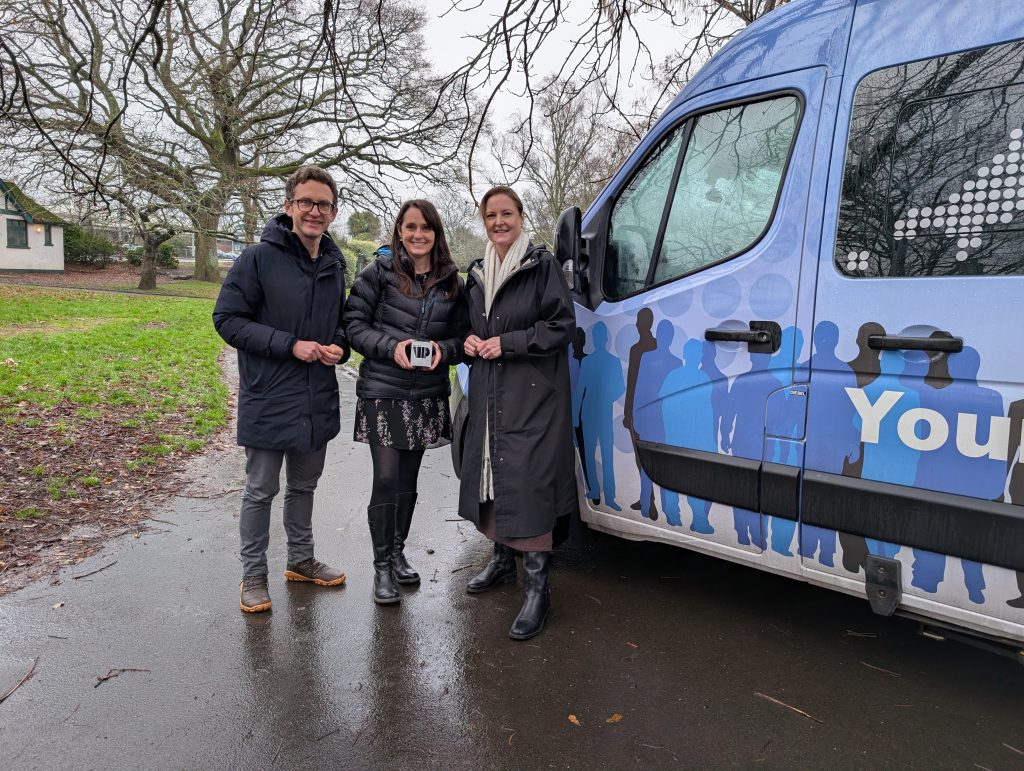
Crucial advice to help parents recognise if their child is being subjected to coercion and control and how to talk to them about it has been shared by a community safety partnership which has developed an impactful Let’s Talk programme.
It is designed to empower parents and carers by raising awareness of the community safety risks and challenges faced by young people such as pornography, drugs and alcohol and relationships, while providing simple tips to support them.
The successful programme is now being expanded further thanks to funding of £100,000 being provided by the Office of the Police and Crime Commissioner (OPCC) as part of its commitment to fund innovative ideas that will help combat violence against women and young girls.
The money will help towards delivering important work including live online sessions to parents, carers and professionals, a Let’s Talk Dad’s Campaign and themed sessions such as misogyny.
Rebecca Hewitt, Teignbridge District Council strategy and policy manager and chair of South Devon and Dartmoor Community Safety Partnership spoke about the Let’s Talk project – which has already had engaged with nearly 9,000 parents – after she was invited to be a ‘VIP’ guest in the third episode of new podcast series Your VIP (Your Voice in Policing) – a reference to Police and Crime Commissioner (PCC) Alison Hernandez’s vital role of acting on behalf of the public to be their voice in policing.
She said: “As a society now, we kind of expect parents to be nutritionists, to be psychiatrists and to be educationalists. There’s so much pressure on parents. The theme of Let’s Talk is very much be a parent, love, support, listen and develop communication.
“For example, a 15 year old girl is in a relationship and starts really well. Maybe the family know them then as the relationship starts to develop, that young girl kind of retracts from her friends. She maybe dresses differently and her behaviour starts to change.
“We see control and coercion in relationships with young people far too often. Our social media and our pornography is where a lot of young people are drawing their life experiences. The online world, is telling them that’s how it’s supposed to be.”
Advising how parents can best speak to their child if they have concerns, she said: “One of the things that we talk about in Let’s Talk is the last thing you want to do is sit your child down right in front of you and say, ‘let’s talk about this’. Use a social media story to talk about the circumstance rather than make it about them or do it side by side on a drive somewhere.
“We also talk to parents very much around being ready when you start that conversation, to not react with judgement and be really clear, and reinforce that you will always be there for them and you care from really early on which is why we’ve started working with parents at pre-school.
Asked for advice for parents who may be worried that asking difficult questions could mean their children stopped talking to them Rebecca said: “The big thing for us is don’t be afraid, but it won’t go away if you don’t try and get a solution. So pushing somebody away a bit for a little bit might be something that you have to accept, but if you’re continually telling them that you love them, that you will always be there for them, those things do matter and they do lead to positive outcomes.”
During the podcast, Rebecca – the 2025 winner of Combating Violence Against Women and Young Girls (VAWG) award at the West Country Women Awards, sponsored by the Office of the Police and Crime Commissioner – explained the important work being carried out by community safety partnerships across the peninsula to tackle VAWG.
She said: “Our approach is very much around looking at the whole community resolution. We’re fully aware that there’s lots of work focusing on those people that do come forward to report, but we don’t want that trauma to have happened in the first place. We want a culture shift.
“What we’re hearing from the young people that we work with is that an awful lot of harmful sexual behaviour has become really normalised. They wouldn’t even think to report it because that’s what happens as a young person.
“What we’re doing is working with young people to tell them that isn’t okay, to tell them what a healthy relationship is, to make it clear that they understand consent, and to talk about the impacts of the pornography that they’re watching.”
The importance of working collaboratively with other agencies to find solutions including the police, social services, youth services, housing providers and addiction services was highlighted by Rebecca who recalled a previous incident at the location where the podcast was recorded – Newton Abbot’s Courtenay Park.
She told how disturbing voyeurism claims of men taking photographs of young girls under the doors of public toilets in the park were tackled after the community safety partnership worked with the council to instal panels to cover the gaps under the toilet cubicles in just two weeks.
Rebecca said: “While we weren’t aware of any incidents actually taking place the fear was in the community and that had to be responded to.”
She also explained powerful community protection warnings (CPWs) can be. She recalled how a man was reported to be upskirting teenagers on buses but it was very difficult to obtain evidence. Working with the police, the community safety partnership secured a CPW to stop him travelling on buses in the district. There have been no further incidents reported since.
In the podcast, Commissioner Hernandez told how VAWG has been an issue throughout the 10 years she has served as PCC For Devon, Cornwall and the Isles of Scilly, and her frustration with ‘poor’ criminal justice results for victims and the latest statistics (below) which show that it has become an epidemic.
She said: “Most women have been a victim of some sort, whether it’s from street harassment all the way up to non-fatal strangulation or even murder. This is why we want to have the conversation about men. It is time for men to help us to step up and change their behaviours because I think some of them don’t even realise that they are being harmful. They’ve normalised it among themselves and that’s the sort of trend that we need to break in society.”
To listen to the podcast and the previous episodes, please click here.
To find out more about the Let’s Talk programme, please click here – Lets Talk – YouTube
VAWG – Key Facts
ALL SEXUAL OFFENCES
- In the 12 months to June 2025, 6,847 sexual offences were recorded in Devon and Cornwall (including rape, sexual assault, and other non-contact offences). This is an increase of 15.0% on the previous year, or an additional 893 offences.
- The rate of increase in Devon and Cornwall (15.0%) has been higher than reported across England and Wales (9.0%)
- Fewer sexual offences achieve a positive outcome in Devon and Cornwall (9.2%) when compared to forces across England and Wales (11.3%).
- Nationally, there has been an increase in the number of sexual offences recorded. This is largely due to the creation of two new sexual offences in January 2024. These relate to sending or sharing intimate photographs or films following the Online Safety Act 2023.
RAPE
- In the 12 months to June 2025, 2,566 rapes were recorded in Devon and Cornwall. This is an increase of 17.2% on the previous year, or an additional 367 offences.
- The rate of increase in Devon and Cornwall (17.2%) is higher than reported across England and Wales (6.0%)
- Fewer rape offences achieve a positive outcome in Devon and Cornwall (8.6%) when compared to forces across England and Wales (9.2%).
- Almost a quarter (24.4%) of all rapes in Devon and Cornwall were reported 12 months or more after the offence occurred (12 months to June 2025).
STALKING AND HARASSMENT
- In the 12 months to June 2025, 15,127 stalking and harassment offences were recorded in Devon and Cornwall. This is an increase of 11.0% on the previous year, or an additional 1,499 offences.
- The rate of increase in Devon and Cornwall (11.0%) has been higher than reported across England and Wales, which saw a -2.0% decrease. Devon and Cornwall Police have called for improved crime recording in this area, which may partially explain some of the increase.
- Fewer stalking and harassment offences achieve a positive outcome in Devon and Cornwall (6.1%) when compared to forces across England and Wales (7.8%).
NON-FATAL STRANGULATION
- In the 12 months to June 2025, 1,645 crimes of non-fatal strangulation were recorded by Devon and Cornwall Police. This is an increase of 10.0%, or an additional 150 crimes, when compared to the year prior.